Handpans and drums · 4 min read
Didgeridoo buying guide: synthetic, sliding, size
What a didgeridoo is, where it comes from, how length sets pitch, plus a look at what three listings from $59.99 to $149.99 include.
By Singing True. Last updated 2026-11-20.
In this guide
If you just want to try one, a synthetic didgeridoo at $59.99 to $69.99 is a reasonable first buy. Check the length and the return policy, and expect the breathing to take practice. A sliding model at $149.99 is for people who want a few pitches from one tube.
We have not played any of these. The facts below come from seller pages and reference pages we opened on 2026-11-20, each named.
What it is, and where it comes from
Wikipedia describes the didgeridoo as a wind instrument played by buzzing the lips to produce a continuous drone. It was developed by Aboriginal peoples of northern Australia, possibly in Arnhem Land. The article gives two age estimates that do not agree: at least 1,000 years in one place, and under 1,000 in another. The Conversation, in an essay on the yidaki, says rock art showing players are carbon dated to 1,000 to 1,500 years ago.
The name matters. Per Wikipedia, "didgeridoo" is an echo of the sound and is not an Aboriginal word. Local names include yidaki among the Yolngu, and mako or mago in West Arnhem Land. The essay says the yidaki is owned exclusively by the Yolngu of north-east Arnhem Land, that it belongs to Yolngu law, ceremony, song and dance, and that yidaki and didgeridoo are not interchangeable terms. The essay also says ceremonial playing is the preserve of men, though women play in less formal settings.
That is worth knowing before you buy. Traditional instruments are made from eucalyptus trunks hollowed by termites, and makers find them by tapping the trees. The instruments below are not that. They are modern designs, and Wikipedia notes that non-traditional versions in materials like fiberglass, resin and PVC have prompted debate about aesthetics, ethics and law. We did not research where to buy a traditional instrument from a community maker, and we do not claim any listing below is one.
How length and shape set the pitch
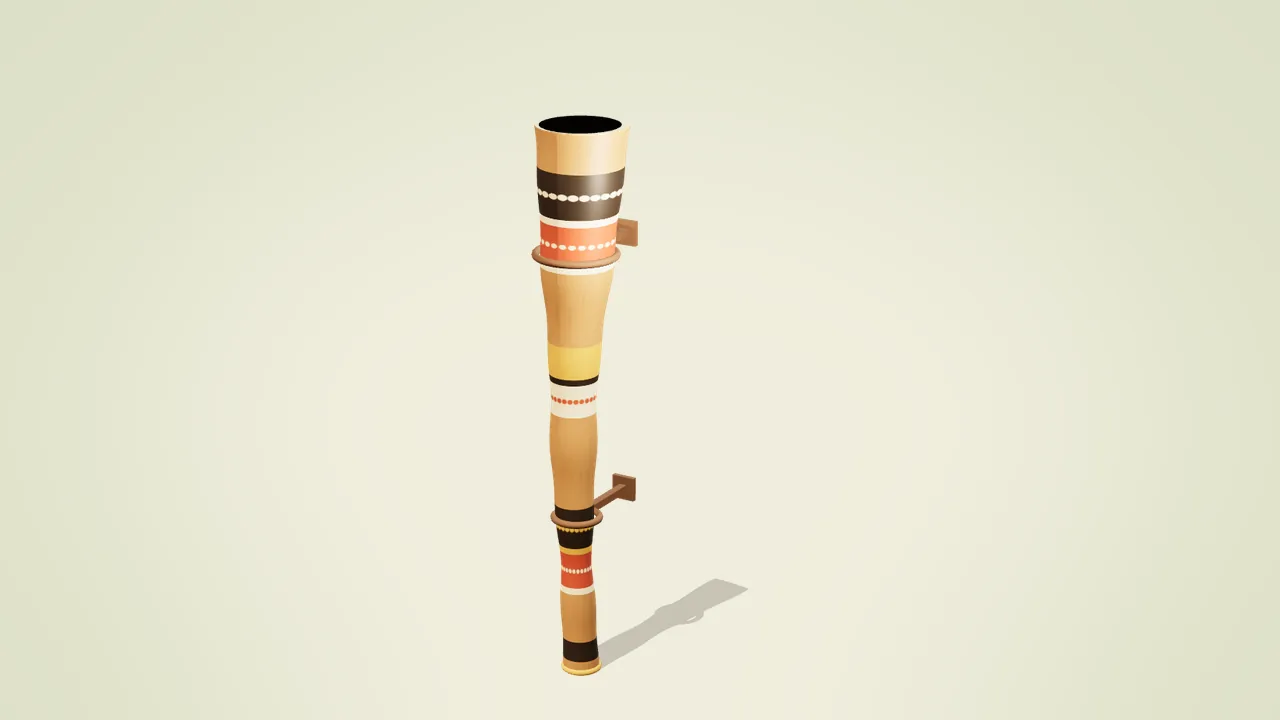
Wikipedia says instruments run from about 1 to 3 m, most around 1.2 m, and that longer ones generally play lower. The listing we read for the Meinl S-shape gives a length of 51 inches (130 cm) and says the S-shaped body elongates the instrument for better tonal development. None of our three listings states a key in our data, so ask the seller or check the page before you buy.
What we saw in listings
- Meinl Synthetic S-Shape: $59.99 at Guitar Center. A lightweight synthetic material the page calls durable and unaffected by weather. The page lists no key and no included items.
- Toca Collapsible, Spider: $69.99 at Guitar Center. A two-piece design that extends to playing length and folds down for transport, with a carry bag. The page lists no material, length or key. The page also offers a Cockatoo style, and the price we read is for Spider.
- Meinl Chakra Didgeridoo, C, D, E, F: $149.99 at Sweetwater. A sliding two-piece design with four pre-tuned notes (C, D, E, F). The "chakra" name is a tradition's label that sellers attach to notes. We do not vouch for it, and the notes are the useful part.
The sliding model costs $90.00 more than the S-shape and $80.00 more than the collapsible (we subtracted the listed prices). More prices are on our didgeridoo price page.
Why synthetic ones exist
Wikipedia lists bamboo, fiberglass, metal, resin, clay, carbon fiber and PVC pipe among modern materials. The Guitar Center page for the Meinl S-shape says its synthetic material is lightweight, durable and unaffected by weather. That is the seller's claim, and we have not checked it.
Playing basics
You buzz your lips into the open end to make the drone. Wikipedia says the sound is shaped by the instrument's bore and by your own mouth and throat.
The skill people talk about is circular breathing. Wikipedia explains it this way: you exhale most of the air in your lungs, puff out your cheeks with the last of it, then squeeze the cheeks to keep air flowing while you quickly breathe in through your nose. The cheek air bridges the gap. Wikipedia says didgeridoo playing relies heavily on it, and cites a concerto with sustained tones lasting more than 50 minutes. Expect to practice it separately from the sound.
What to check before you pay
- Length. Longer plays lower and is heavier to hold. Check it in inches or centimeters.
- Key or notes. Only the Meinl chakra model names its notes in our data.
- Material. Name it plainly.
- Mouthpiece. Ask whether it is sealed or shaped for the lips.
- Carry gear. The Toca lists a bag. Check the others.
- Return policy. For a first instrument, you want the option.
Ways people overpay
- Paying for a decorative finish when you want a first sound.
- Paying for four notes you may not use before you can hold a drone.
- Buying something sold as a traditional instrument with no named maker. Wikipedia's account of traditional making is specific: a hollowed tree, found by tapping. Ask who made it.
What else you need
A bag, and room to practice. If you are building a set for a sound bath, see what you need to host a sound bath. For a cheap first set, read first sound bath kit on a budget. The whole catalog is on our instruments page.
Frequently asked questions
What is a didgeridoo?
A wind instrument you play by buzzing your lips to make a continuous drone. It was developed by Aboriginal peoples of northern Australia, per Wikipedia. The word didgeridoo is not an Aboriginal one, and local names include yidaki and mako.
Does the length change the sound?
Yes. Per Wikipedia, longer instruments generally play lower, and most are around 1.2 m. A flared one plays higher than an unflared one of the same length.
What is circular breathing, and do I need it?
It lets you keep sounding while you breathe in through the nose, using air held in your cheeks. Wikipedia says didgeridoo playing relies heavily on it. You can make a sound without it, but a continuous drone needs it.
How much does a didgeridoo cost?
In the three listings we read on 2026-11-20, a Meinl synthetic S-shape was $59.99, a Toca collapsible was $69.99 and a Meinl sliding four-note model was $149.99.